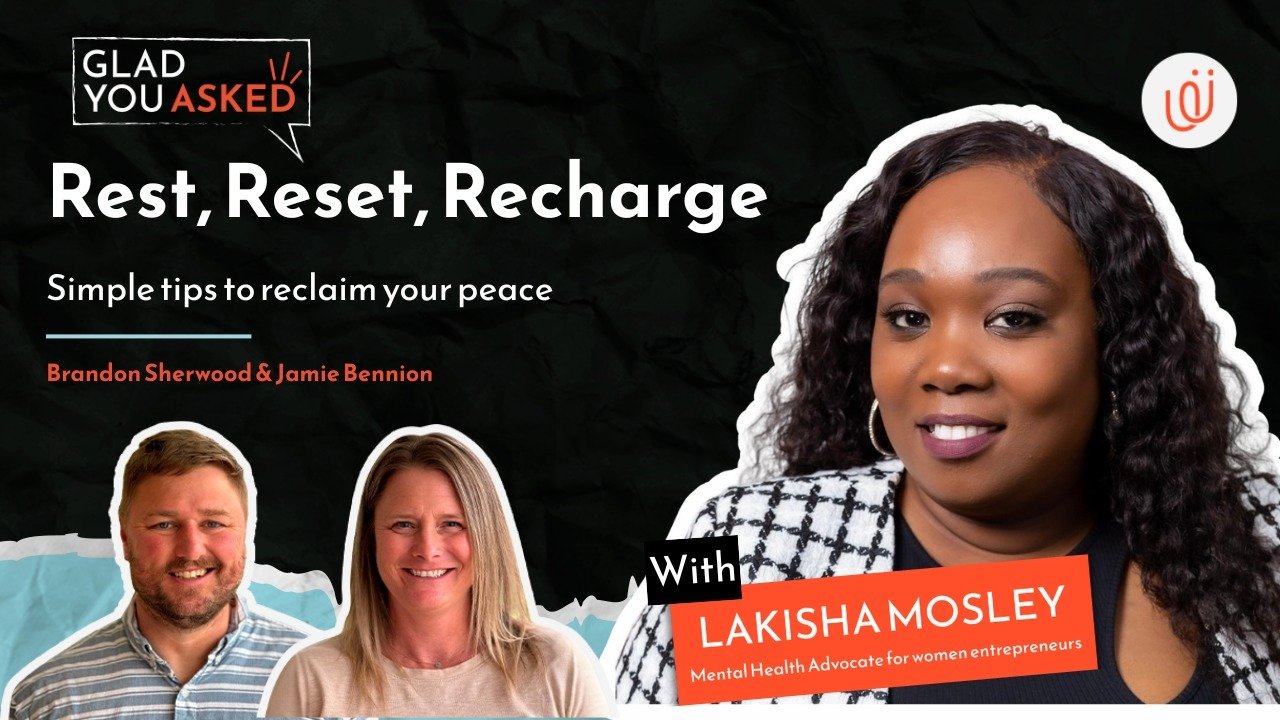
In this episode of Glad You Asked podcast, host Brandon Sherwood sits down with LaKisha Mosley, a mental health advocate and coach whose work focuses on helping people, particularly women, reclaim rest, protect their peace, and release the guilt that often comes with slowing down. The discussion explores how boundaries, personalized recovery, and even five-minute resets can reshape the way leaders think, operate, and show up for their teams.
The Culture of Exhaustion and Why It Weakens Leadership Output (9:14 to 10:28)
When asked to explain the mindset behind today’s burnout culture, LaKisha goes straight to the source.
Quote from LaKisha:
“A lot of us were raised in a culture that worships like exhaustion. Like it is a badge of honor to say I am busy or oh girl, oh dude, oh bro, I am tired.” (9:22)
She continues by describing how women in particular are conditioned to push through depletion, care for everyone else first, and then feel guilty for both resting and burning out.
For business leaders and IT decision makers, the consequences go beyond personal fatigue. Chronic exhaustion reduces cognitive clarity, increases reactivity, and limits strategic vision. When leaders normalize operating on empty, it affects communication, change management, and team performance.
Rest as Reset and Strategy for Business Owners (10:37 to 11:12)
LaKisha reframes rest not as a prize you earn but as something you already deserve.
Quote from LaKisha:
“I feel like rest is not like a luxury or a reward for doing something. Rest is what is naturally ours. It is a reset button that allows us to show up for the things that matter, but allows us to slow down. And for those of us who are business owners, it is a straight strategy. I think a lot better when I am rested.” (10:44)
Leaders responsible for communication systems, customer experience environments or technical architecture make better decisions when they are rested. Rest sharpens critical thinking, reduces errors and supports more sustainable planning. In rapidly evolving digital and operational environments, clarity is a competitive advantage.
Peace Is Personal and Not Up for Negotiation (24:36 to 26:10)
When the hosts ask why peace must be personalized, LaKisha is clear.
Quote from LaKisha:
“We have to be personalized in that because peace is personal. Some people are like, well, this wrecks my peace and that. How? Because if peace is so personal, it is up to you. You have to decide. There is a choice in all of this, what you are going to decide to let bother you.” (24:50)
She then shifts the common phrase “protect your peace” into something more assertive..
Quote from LaKisha:
“We do not go with the status quo of ‘Oh, let us protect our peace.’ I am not protecting our peace, baby. It is mine. You cannot have it.” (25:41)
In distributed or hybrid work environments, one-size-fits-all all approaches to wellness fail. Recognizing peace as personal allows leaders to honor individual differences, reduce guilt around taking breaks, and create cultures where people can operate at their best capacity.
Boundaries, CEO Days and Modeling Healthy Capacity (15:20 to 15:53)
LaKisha emphasizes that protecting capacity is not theoretical. It requires clear, consistent boundaries.
Quote from LaKisha:
“My kids are grown, but they're still here, in the same zip code. But it is like, okay, today is not the day. This door is closed. Do not bother me. Do not come in here. When we go to block our schedules, I block a soft CEO day. That is my day. Do not come in here. Do not bother me. I am good. I have a fridge in my room. I do not have to leave.” (15:20)
Uninterrupted time is rare for leaders, yet it is critical for strategic clarity and long-term planning. When leaders model boundaries, they normalize healthy expectations and create room for their teams to adopt similar practices. Good communication systems depend on leaders who are grounded, not overwhelmed.
The Five Minute Soft CEO Reset (29:02 to 30:05)
When schedules are full and commitments are stacked, LaKisha relies on a simple yet powerful micro practice.
Quote from LaKisha:
“For me, I have what I call my five-minute soft CEO reset. And that is really just sitting with myself. The phone, like I just threw those phones across the room. I get in a space where they are not there. Even if it is my closet, I just sit there and think about what I am grateful for. Just sitting in the moment helps me reset, because sometimes all we have is five minutes before the next meeting or the next report is due.” (29:02)
Micro recovery matters in high-demand roles. These short breaks enable leaders to return to conversations, decisions and technical challenges with more clarity and composure. When communication environments rely on rapid problem solving, even a five-minute reset can influence the outcome.
Human Capacity as Core Infrastructure
Throughout the episode, LaKisha reinforces a consistent truth. Rest is not optional. Peace is not accidental. Grace is not weakness. These are essential components of healthy leadership and resilient teams. As organizations modernize their communication systems and build more scalable, human-centered environments, leaders who manage their own capacity set the tone for everyone around them.
To explore the full conversation, you can watch the YouTube recording, listen on Spreaker, or listen on Spotify.
About Gladly
Gladly is a purpose-driven perks platform designed to reward the people who give their all, both companies and customers. Through curated travel tools and exclusive product deals, Gladly connects users with brands that reflect values like sustainability, wellness, and social good.
Contact Information
For media inquiries or to learn more about Gladly Network and our purpose-driven marketplace, please visit gladlynetwork.com
For executive insights or interview opportunities, please reach out to: